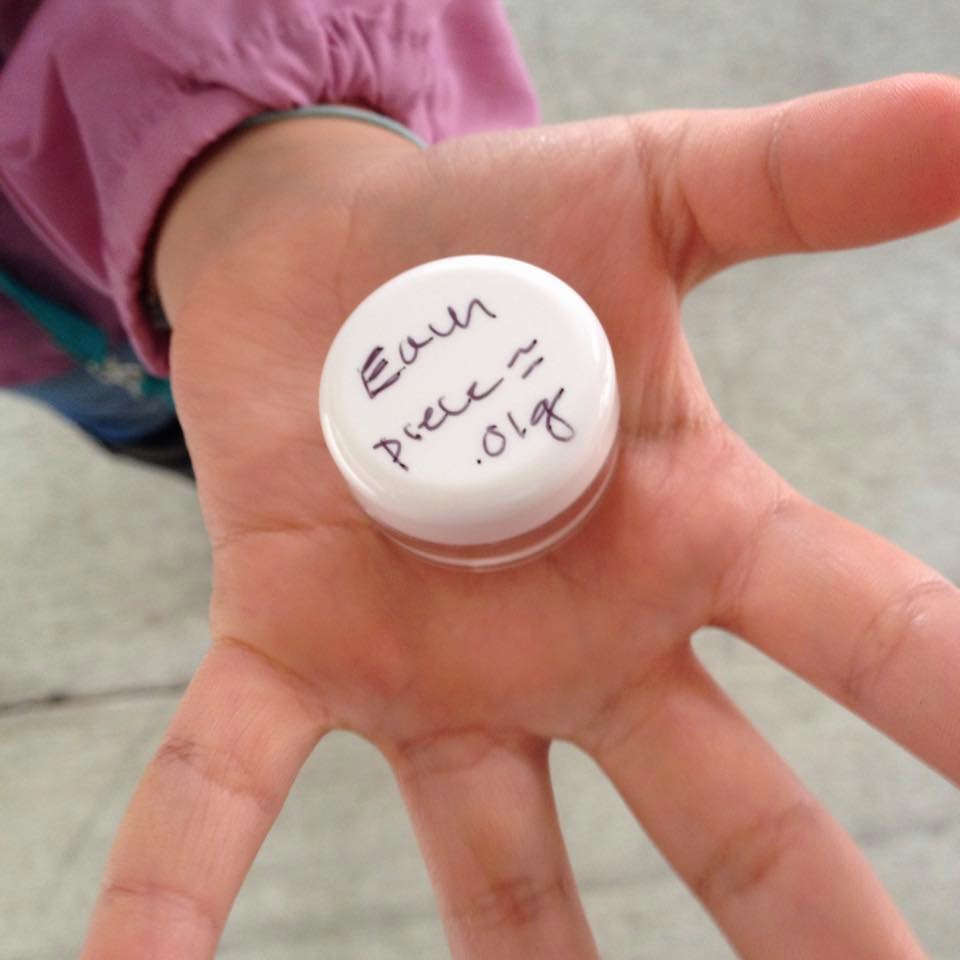
A year ago, if someone had told me that my shelves would be filled with Reces Pieces and Peanut M&M's, I would have thought you were crazy. But today, when we stop by the drugstore, we always pick up at least one bag of both. The conversation always goes something like this:
Cashier: "Oooohhh, that looks yummy! Are you guys having snacks tonight?"
Mary: "That's my medicine."
Cashier: "That is silly, candy can't be medicine!"
Mary: "You're wrong. I am allergic to peanuts, but I finished OIT. So that means I have to eat peanuts in the morning and at night. So that is my medicine."
Cashier: (To me) "Gosh, that must be nice medicine. I wish I had to take that for medicine!"
Mary: (Before I can speak) "No, it is a tiny bit yucky. But it means I won't die from peanuts. So that is okay."
Never, in my wildest dreams, could I have imagined having this conversation (none-the-less imagining my 7 year old asserting herself and educating random strangers about food allergies).
Our journey has been difficult (to say the least). While we had suspected a peanut allergy for some time (that is another story for another time), she was officially diagnosed in 2011. That day marked the beginning of a long, scary, traumatic journey. Mary went into anaphylaxis minutes after her test began. Everything after that was a blur.
Over the next couple years, we battled. We were on guard. We carried wipes and epinephrine everywhere. And we kept her reaction free. Until November 20th, 2013. That day will be permanently etched in my mind. Mary had been sick that day (which is likely what set the stage for her reaction). After insane amounts of fighting, we had convinced the school to agree to whole class handwashing after meal and snack periods. When we spelled it out for them, apparently, saying that "Ice Cream Day" was a snack period was not clear enough. No one washed their hands, and Mary touched a surface that had peanut residue. She had an initial delayed reaction and a biphasic reaction.
After sitting in the back of two different ambulances, in the ER, I promised myself, Mary, and God that this would never happen again. Aaryn and I had talked about OIT before, but I was so scared. Nothing made it less scary. I just was more afraid of losing her.
It took a while to get Mary ready for OIT. She has both Asthma and Mast Cell Activation Syndrome. This means that it took a lot of work to stabilize her enough to handle OIT. After lots of work, we scheduled our first appointment. November 3rd, 2014. Almost exactly one year to the date.
I was terrified. But I refused to show it. I completely trusted Dr. Baker and his staff, so I knew that if anything bad happened, they would know how to handle it. I chose to not tell Mary about side effects...I did not want her to go in expecting something to go wrong. I simply said "it may be yucky, but it is going to mean that you can be safe...no more fear of dying" (Mary had asked if peanuts would kill her multiple times by this point).
On that day, we arrived early. I showed up with enough snacks and entertainment to keep a small army busy. They took baseline vitals, and then started with her first dose. I watched her so closely that I am sure she thought I was crazy. And...nothing. Then the next dose. And the next. Finally, Dr. Baker came in and said that they would call it quits for the day so we did not get sick of looking at each other! And that was it. They sent us on our way with tiny little pieces of peanuts. It was the craziest thing ever.
We came back week after week. Within an amazing six short weeks, Mary hit maintenance. And that was it. No drama. No chaos. No catastrophe. In six short weeks, our lives changed forever. The fear was gone.
We still have to read labels (Mary is considered "Bite Proof" but does not eat above her dose). We still carry epinephrine everywhere. But that fear is gone. Mary can return (safely) to school. She can have birthday cake. She can live....without the fear of dying.
Saturday, January 10, 2015
Sunday, October 19, 2014
Five to Stay Alive!
While managing allergies and anaphylaxis has become the norm for most of us, for those AMAZING friends and family who interact with our loved ones with allergies, the thought can be overwhelming (to say the least)! OrAAA wants to help you out! Check out our Five to Stay Alive (and share them with those awesome loved ones)!!
1. Learn The Signs of Anaphylaxis
First and foremost, the best way to ensure your kiddo (or other loved one) gets assistance quickly is to ensure that everyone around them is aware of the signs of anaphylaxis! You can learn more about the signs of anaphylaxis here.
2. Know your loved one's Emergency Action Plan.
Has your allergist given you an Emergency Action Plan or Food Allergy Action Plan? Make sure you know what your loved one's plan says.
3. Take 2...Every time, All the time!
Did you know that an recent study found that only (approximately) 40% of patients had epinephrine with them (at appointment time) despite 60% knowing that they needed to carry it all the time (study here)? Make sure you have AT LEAST two epinephrine auto-injectors with you all the time! FARE has some great door hangers (here) that can help remind you and your loved one!
4. Learn how to administer Epinephrine.
Since successful administration of epinephrine is key to good outcomes, it is imperative that everyone around your loved one knows where their epinephrine is kept and how to administer it.
More than likely (if you are in the US), your loved one is carrying one of 3 auto-injectors.
If your loved one has an EpiPen, EpiPen Jr., or Adrenaclick, check out this video for a quick how-to on these auto-injectors.
If your loved one has an Auvi-Q, check out this video!
5. Make sure you (or your loved one) are wearing Medical Id Jewelry.
In an emergency, Medical Id Jewelry is the best way to ensure someone can tell responders important health information about your child quickly! Vital info to include: Name, Allergy, medication (and location if possible). You can read here for more information from FARE about the importance of Id!
Remember, while reactions can be frightening, preparation can make it SO much easier!
Friday, October 3, 2014
The Elephant In The Classroom...Part Two
In our last post, we decided to take on the proverbial elephant in the classroom...the life threatening nature of food allergies (and the implications of LTFA's in school).
Reporting of death from anaphylaxis is tricky at best. That being said, deaths at school (from anaphylaxis) have (as far as we know) been fairly accurate and consistent as the internet has become an integral part of our lives. We live in the age of instant information, and, as such, we learn about these tragedies quickly. (For a discussion on why death due to anaphylaxis reporting is inconsistent, check out this discussion, forewarning, it is lengthy).
Despite an increase in reported deaths in schools, they appear to be relatively infrequent. That being said, anaphylactic reactions at school are not. We (OrAAA) have both had incidences of our children having allergic reactions at school (my daughter went into anaphylactic shock in November of 2013). According to the CDC, somewhere between 16-18% of food allergic children have had at least one allergic reaction at school, with 25% of those reactions ocurring in students that were not previously diagnosed with food allergies (http://www.cdc.gov/healthyyouth/foodallergies/pdf/13_243135_A_Food_Allergy_Web_508.pdf). These appear to be consistent with OrAAA's recent survey.
While students with food allergies (in general) and allergic reactions in school appear to be increasing, access to accommodations that help ensure the safety of food allergic students can be difficult to codify (nonetheless enforce). Protests over accommodations are becoming more common, often pitting parents of food allergic and non-food allergic children against each other (at a time when support and unanimity is most needed). Retaliation, harassment, and bullying (of both students and parents by both students/families and school staff) are common occurrences. Battles over accommodations often include complaints or administrative hearings of different types. In our study, close to 15% of parents reported having filed at least one complaint on behalf of their child/themselves.
What has become clear is that while this issue is not currently being remedied in a time and fashion that ensures the safety of food allergic children currently in school, it is an issue that will have to be addressed soon. Check back with us next week for our thoughts on the solution to this problem!
Sunday, September 7, 2014
The Elephant in The Classroom, Part One
Normally, we stick to try to focus on the positive. We are a "thriving with food allergies" kind of group. However, we have noticed a trend...schools treating life threatening food allergies as if they were anything but that. So...here we go.
The subject of children who die due to anaphylaxis in school is not one often talked about. Sure, we talk about our worst fears. We talk about the few we know. But very few of us know how many have actually died in school. Why? Well.........
We owe it to our loved ones...those who have died in school to anaphylaxis to remember them. To burn each of their names into our memories. So, today, remember, when fighting for change, remember these names. (We have also included a slideshow that we created just for our friends and family of some of the school/non-school anaphylaxis losses experienced).
"Breathe. Listen for my footfall in your heart. I am not gone but merely walk within you."
- Nicholas Evans
- Nicholas Evans
Sunday, August 10, 2014
Oregon AAA Alliance Needs Your Help!
The Oregon AAA Alliance Family is working on an exciting project and needs your help! We are looking at experiences of food allergic students in schools! We want to hear from all parents (public, private, and home school!). Take this short survey and share! https://www.surveymonkey.com/s/foodallergyexperienceinschool
Sunday, June 15, 2014
Chocolate, Chocolate, and more Chocolate!
Normally, we here at Oregon AAA Alliance are not going to be big on promoting one company over another. That being said, every once and a while, an AMAZING product comes along, and we are just TOO excited to not say something!
That moment came today!
TWO WORDS FOLKS...PREMIUM CHOCLATIERS!
We first heard about their Mini PeaNot Cups. Since my kiddo was diagnosed with a peanut allergy, I have been jonesing for a Reces Peanut Butter Cup like no one's business. But, I lived with it. Because compared to my daughter having an allergic reaction. And then I heard about Premium Choclatiers. Originally, I was tempted to buy my entire paycheck's worth, but I remembered that some brands promise to "taste like the original" and end up tasting like cardboard. So, I bought one and patiently awaited. HEAVEN!!! I won't tell you how quickly I ate that, but we will just say it did not last as long as it should have!
After that, I looked at their other products. I was drawn to the No Whey and No No's. Again, hesitant, I went with just one package of each. Got them yesterday, and WOW!
So, here is my specific reviews of each:
Mini PeaNot:
-Tastes Like The Real Thing
-Use of Wow Butter gives great texture
-Treatment of Chocolate makes it SUPER close to Reces
No Whey:
-OMG...this totally tastes like Snickers!
-Carmel is Delish...gooey, good flavor
-Nougat is perfect
No No's:
-Cannot compare this to another candy (in flavor) but they are great. They get the 6 year old allergic girls seal of approval
-Look similar to M&M's for cake decorating, etc.
Now, I know that some folks will complain about the price. Folks, You get what you you pay for. For a couple more bucks, I am THRILLED to put out the money to get something I have not had in forever (after all, haven't we all been eating the same stinking 3 pieces of candy forever)!
They label their candy as Gluten Free, Dairy Free, Egg Free, and Nut Free. My understanding is that they do still contain Corn and Soy.
I have an email out to Premium Choclatiers. If I hear anything, I will update you. You can check out their info yourself here!
Sunday, May 18, 2014
An Amazing #TealTakeover week!
Now that Food Allergy Week has passed (and we can all return to our normal, slightly less teal lives), I wanted to take a few moments to reflect on the lessons that Food Allergy Awareness Week (and the accompanying #TealTakeover) have taught me!
1.When we hear about all of the ugliness in the world (parents protesting nut bans, tantrums over nut free celebrations, etc.), it can be easy to convince ourselves that this is reality. Not everyone is difficult. Most folks want to keep our children safe. And if they don't, it is normally because they don't get them. If you are running into resistance, tell them if you saw their kid dart into traffic, you would run out to save them. You are just asking for the same. We saw teal come from some very amazing places!


2. There are a TON of super fun ways to celebrate without food! On 05/13/2014, we dubbed the day "Teal Tuesday". It just so happened to coincide with school awareness day. We had a blast! Mary rode a fire truck to school (and got to chat it up with some super fun fire fighters who looked over her Medic Alert bracelet (and gave mom the thumbs up), shared teal glow bracelets, Be a P.A.L. pencils, stickers, and more! And she (as well as other not-so vocal kiddos with food allergies) got to see their school support them in a very public way!

3. Most importantly, when we partner together, we can make a difference. This week was amazing. I felt for the first time that my daughter and I were working together for change...for knowledge!


Subscribe to:
Posts (Atom)